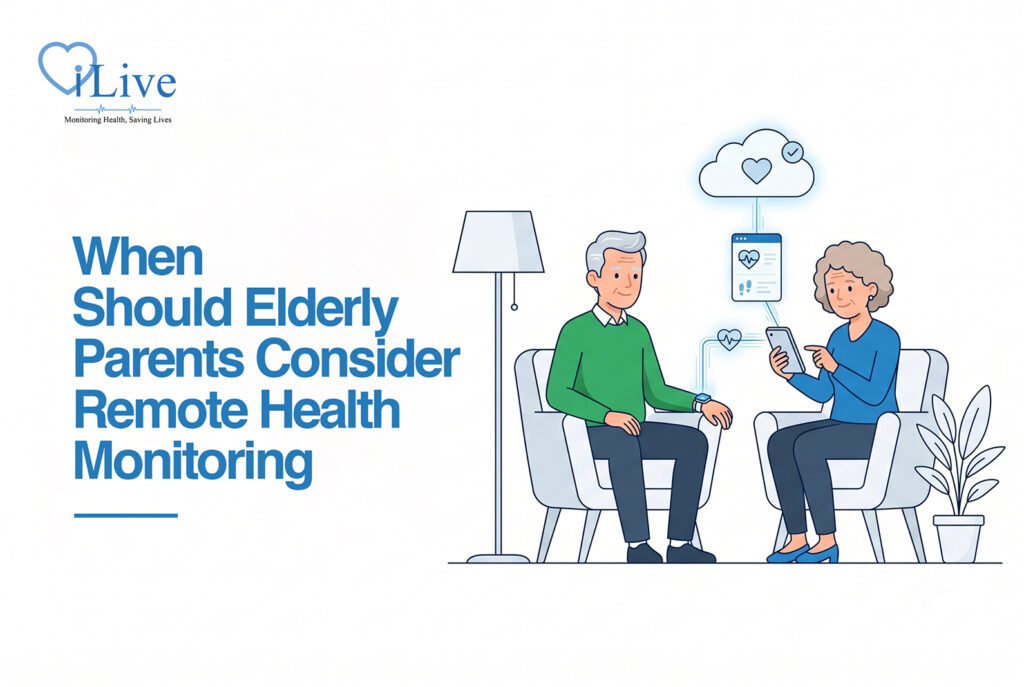
When parents get older, the concern is not always about a major health problem. Sometimes it is the small things that make a family pause. A parent seems more tired than usual. They have recently come home from the hospital. They live alone and have a health condition that needs regular attention.
For families who cannot be physically present every day, these situations can raise an important question: do my parents need remote health monitoring?
There is no fixed age at which someone should start using it. The decision depends more on their health needs, daily circumstances and how closely their wellbeing needs to be observed.
Not every elderly person needs continuous remote health monitoring. It may be worth considering when there is a specific health or care-related reason for closer observation between routine consultations.
You must opt for Remote health monitoring if your parents
In such situations, health monitoring for parents can give families and healthcare teams a clearer picture of changes that may happen between appointments.
Living alone does not automatically mean an older person needs continuous health monitoring. Many older adults live independently and manage their routines well.
The question is what happens if their health changes while nobody is around.
A phone call can confirm how someone feels at that moment. It cannot show how their health parameters have changed throughout the day. This is where elderly monitoring solutions can provide another layer of visibility.
For families, that can mean fewer conversations based purely on guesswork and more information to discuss with healthcare professionals when something changes.
Returning home after hospitalisation can be reassuring, but recovery continues outside the hospital.
Depending on the person’s condition and their doctor’s advice, Health monitoring at home after hospital discharge may help provide ongoing information during this period. Instead of relying only on the next scheduled appointment, relevant health trends can be observed while the person returns to their normal routine.
This is particularly relevant when families are concerned about what may happen between discharge and follow-up.
Not every monitoring service offers the same level of support. A device that records a health reading and a system that combines continuous monitoring with clinical oversight are two different models.
When comparing Health monitoring solutions for elders, families can ask:
These questions matter because collecting health data is only one part of the process. What happens after the data is collected can be just as important.
A health monitoring device can collect readings. But for families caring for an elderly parent, the more important question is often: who is looking at that information when something changes?
iLive Connect combines connected medical devices with 24/7 doctor-led health monitoring. Health parameters captured through its biosensor devices are continuously analysed, with AI-enabled technology helping identify changes or unusual patterns that may require attention.
When an alert is generated, it does not simply remain as a notification on a screen. The information is reviewed by doctors and trained clinical professionals at the 24/7 Clinical Command Centre. They monitor the situation and assess whether the change requires immediate attention or further follow-up.
This creates an important difference between simply collecting health data and having a clinical team actively monitoring it. For families who cannot be beside an elderly parent throughout the day, it means there is a medical team keeping watch on the monitored health parameters and responding when an alert needs attention.
For those considering 24/7 health monitoring for elderly parents, iLive Connect brings together continuous monitoring, AI-enabled analysis and round-the-clock doctor-led clinical oversight, creating an additional layer of support at home.
The right time is not necessarily when a parent becomes frail or dependent. It may be earlier, when a family recognises that regular check-ins are no longer enough to answer their concerns.
For some, that may be after a hospital discharge. For others, it may be when a parent begins living alone or requires closer observation because of an existing health concern.
The WHO reports that the global population aged 60 and above is expected to reach 2.1 billion by 2050, highlighting how quickly the need for age-friendly health and care systems is growing.
For families navigating this change, remote health monitoring for elderly parents can provide another way to stay connected to their wellbeing without taking away their independence. iLive Connect brings continuous monitoring, AI-enabled analysis and 24/7 clinical oversight together to support that connection at home.