The hospital bed is empty. The discharge papers are signed. The medicines are neatly packed into a bag.
For the family, however, the worry has only changed its address.
Going home after an illness, surgery or prolonged hospital stay is often seen as the final step in treatment. In reality, it is the beginning of another important phase: recovery. Someone may appear stable, but the body can still be adjusting. Medication changes, reduced mobility, fatigue and fluctuations in vital signs can create new challenges once professional care is no longer immediately available.
This is why post hospital care at home needs to be more than medicines, occasional calls and scheduled follow-up visits. Recovery needs continuity, visibility and timely attention when something changes.
The transition from hospital to home can be deceptively difficult.
Those recovering at home may have to manage multiple medicines, dietary restrictions, wound care, mobility exercises and follow-up appointments. At the same time, families need to watch for changes that could indicate a complication.
For older adults, this can become particularly challenging. An elderly parent recovering at home may not always recognise that a change in energy, activity or breathing deserves attention. Family members living in another city or country may find it even harder to know what is happening between phone calls.
The result can be a quiet gap between discharge and the next medical consultation.
This is where Remote Health Monitoring can play an important role. Connected health devices can capture selected health parameters from home, giving healthcare professionals a more continuous view rather than relying only on what happens during appointments.
It does not replace a doctor. Instead, it adds another layer of information between consultations and can help bring potentially meaningful changes into focus.
Recovery is rarely a straight line. Someone can feel better one day and experience a setback the next. Some changes may be obvious, while others can remain unnoticed until symptoms become more serious.
Consider an elderly person returning home after a cardiac episode. The first few days may appear uneventful. Gradually, however, their heart rate may start behaving differently, activity levels may decline, or other measurements may move away from their usual range.
Without health monitoring at home after hospital discharge, such changes may simply be attributed to tiredness or the normal recovery process.
With connected monitoring, changes can be tracked over time and viewed in context. This can give families greater awareness and healthcare professionals additional information to consider when assessing recovery.
Research increasingly points towards the potential value of this approach.
A 2024 systematic review published in npj Digital Medicine examined 29 randomised controlled trials across 16 countries involving remote monitoring during the transition from inpatient care to home. The review reported positive outcomes related to safety and adherence, while some studies also showed improvements in mobility and functional status. It also found a downward trend in hospital admissions and readmissions, although outcomes varied across different interventions.
A newer systematic review and meta-analysis covering 39 studies and 160,857 people found that remote biometric sensing was associated with a 25% lower risk of all-cause readmission. The association was particularly encouraging during the first 30 days after discharge. However, the researchers also noted that further research is needed to validate these findings across different groups and care settings.
These findings highlight an important point: the period after discharge deserves attention, not just the moment of discharge itself.
There is an important distinction between collecting health data and providing meaningful healthcare support.
A wearable device can measure vital signs. An app can display numbers. But for families, the real question is often: What do these changes mean, and when should someone pay attention?
This is where iLive Connect takes a broader approach to connected care.
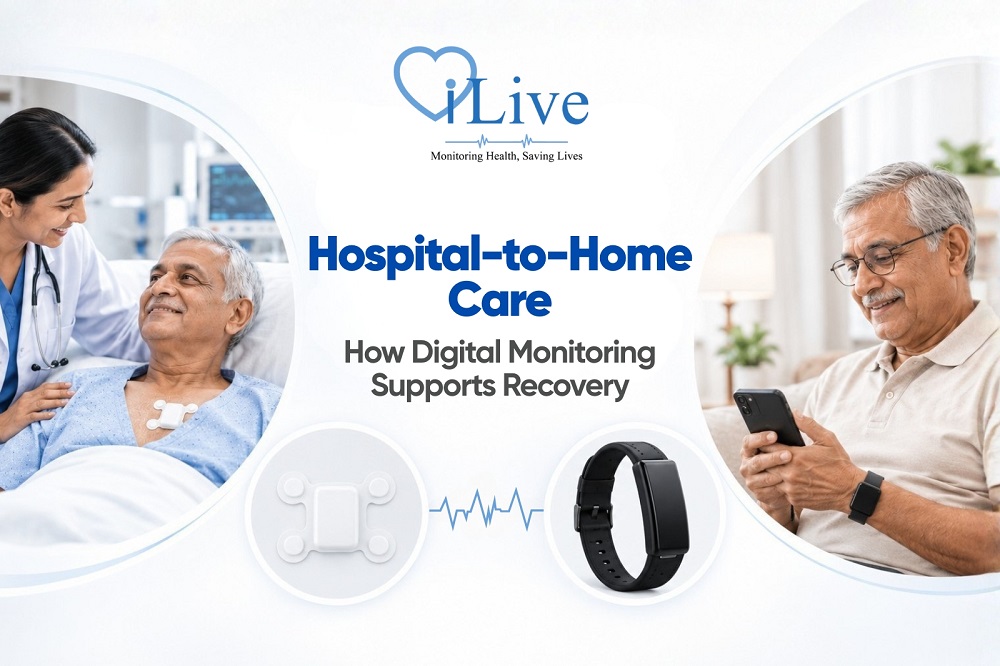
Its ecosystem brings together wearable health technology, AI-enabled insights and clinical oversight. The platform uses an FDA- and CE-approved biosensor patch and a wristband to capture health information, while the Health Insight App helps present that information in an accessible format.
More importantly, the data does not simply stop at a dashboard.
iLive Connect combines technology with an expert physician-led command centre, creating a system in which health information can be monitored and interpreted with clinical context. AI-enabled insights can help identify patterns, while healthcare professionals provide the human oversight needed to understand what those patterns may mean.
That distinction matters.
The purpose is not to make someone recovering at home responsible for interpreting every health metric. Nor is it to suggest that technology can replace medical care. The objective is to create greater visibility between the hospital, the individual, the family and the healthcare team.
For families living away from their parents, this can offer something equally valuable: reassurance backed by health information rather than reassurance based only on a phone call.
Post Hospital Discharge should not feel like a sudden handover from professional healthcare to family responsibility.
The hospital may be where treatment happens, but recovery continues at home. That recovery can involve changing symptoms, medication adjustments, reduced mobility and uncertainty about what is normal and what requires attention.
A stronger care model connects these two environments.
For those recovering at home, this can mean staying connected to their health while remaining in familiar surroundings. For families, it can mean better visibility when they cannot be physically present. For healthcare professionals, it can provide additional information about how recovery is progressing outside the hospital.
Technology cannot remove every risk associated with recovery. But it can help close the information gap that often exists after discharge.
The journey home should be a step towards recovery, not a step away from healthcare.
At iLive Connect, Post hospital care at home becomes more meaningful when people are not left to navigate recovery with limited visibility. Connected monitoring, when combined with clinical oversight, can help create a more informed and continuous care experience.
That is the approach behind iLive Connect: bringing together connected devices, AI-led health insights and physician oversight to help families stay closer to the health of their loved ones, even when distance makes physical presence difficult.
Because after the hospital doors close, recovery does not stop.
And neither should the connection to care.