Heart problems rarely announce themselves at a convenient time. A person may feel perfectly fine in the morning and experience unusual breathlessness by evening. Someone recovering from a cardiac procedure may look well at home while their vital signs are quietly changing. For an elderly parent living alone, a small change in heart rate, oxygen level or breathing pattern may go unnoticed until it becomes difficult to ignore.
This is where remote heart monitoring can make a meaningful difference.
Instead of relying only on occasional check-ups, remote monitoring allows certain health parameters to be tracked while a person goes about their day at home. The goal is not to replace the doctor or turn every heartbeat into a reason for concern. It is to give doctors a clearer picture of what is happening between appointments, when people are living their normal lives.
The American Heart Association has noted that remote patient monitoring can give clinicians a broader view of health over time and support timely intervention when changes are detected.
Remote monitoring can be particularly useful for people whose heart health needs closer observation. Here are some groups who may benefit.
1. People Living with Heart Disease
For someone already diagnosed with a heart condition, regular monitoring can provide useful information beyond a periodic hospital visit.
Conditions such as heart failure, coronary artery disease and certain rhythm disorders may require ongoing observation. Changes in heart rate, oxygen saturation, breathing rate, activity levels or other vital parameters can provide doctors with additional information when viewed alongside symptoms and medical history.
It is important to remember that remote heart health monitoring is not a diagnostic substitute. It works best as part of an overall care plan created by a qualified healthcare professional.
2. People Recovering After Hospitalisation
Coming home after a cardiac event or hospital stay can bring a strange mixture of relief and uncertainty.
The hospital may have provided constant observation, but home does not. The first few weeks can be especially important as the person adjusts to medication, activity and daily routines.
The American Heart Association notes that nearly one in four heart failure patients is readmitted within 30 days of discharge. Its Connected Care programme highlights the role of ongoing support and monitoring after patients return home.
For such individuals, continuous cardiac monitoring solutions can help bridge the gap between hospital discharge and everyday life.
3. Senior Citizens Living Alone
For families living in different cities or countries, the words “I’m fine” can sometimes leave more questions than answers.
An elderly parent may not always mention mild breathlessness, fatigue, dizziness or changes in activity. Children may want to stay involved but cannot physically be present every day.
Remote monitoring can provide another layer of visibility. Instead of depending entirely on phone calls, families and care teams can have access to relevant health information and respond when something changes.
This is particularly meaningful for families managing the health of parents from a distance.
4. People with Multiple Risk Factors
High blood pressure, diabetes, high cholesterol, kidney disease and excess weight can all influence heart health. The American Heart Association recommends keeping track of important health numbers because changes can sometimes occur before noticeable symptoms appear.
For people managing several of these risk factors, preventive heart health monitoring can become part of a larger effort to understand their health patterns.
The emphasis should be on awareness rather than anxiety. Monitoring is most useful when information leads to an appropriate conversation with a doctor or a timely change in care.
5. People Who Need Closer Observation but Want to Stay at Home
Not every health concern requires a hospital bed.
For some people, especially those with chronic conditions or those recovering after treatment, being at home can be more comfortable and less disruptive. Remote monitoring can allow healthcare professionals to keep an eye on relevant parameters without requiring the individual to repeatedly travel to a hospital or clinic.
Research has also explored this approach. A randomised trial involving 202 high-risk people with chronic heart failure in the UK examined technology-supported home monitoring combined with specialist support. Participants used connected devices including blood pressure monitors and weighing scales, while the intervention group received additional clinical support.
The research reflects an important idea: technology becomes more useful when it is connected to appropriate clinical care rather than being used simply to collect numbers.
Modern systems can go beyond simply counting steps or measuring pulse occasionally.
Depending on the technology and care programme, monitoring may include heart rhythm, heart rate, respiratory rate, oxygen saturation, body temperature, blood pressure trends, physical activity and heart rate variability.
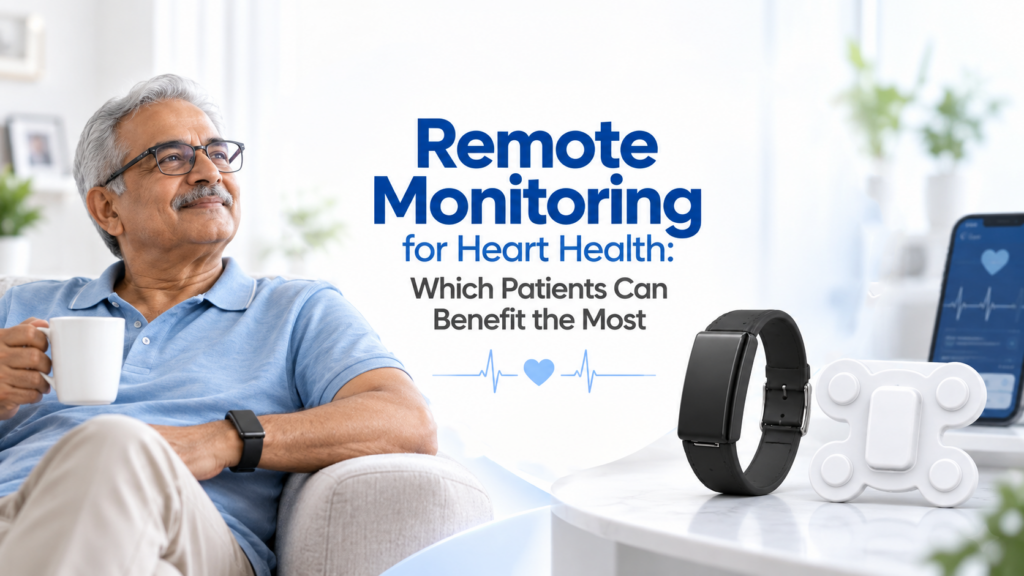
For example, iLive Connect uses a wearable biosensor patch paired with a wristband to continuously capture several physiological parameters. The information is transmitted to a secure platform and made available to a dedicated medical command centre.
This continuous stream matters because a single reading is only a snapshot. A series of readings can tell a more complete story.
That story can help doctors notice patterns, ask better questions and decide when a person may need medical attention.
AI should not be thought of as a replacement for a doctor. Its value lies in helping process large amounts of health information and identifying patterns that may deserve attention. In AI heart health monitoring in India, combining wearable sensors, data analysis, and clinical oversight can help healthcare teams track changes over time.
The human element remains essential. A number on a screen has little meaning without context: the person’s medical history, symptoms, medication, age and overall condition all matter. That is why doctor-led monitoring can be different from simply wearing a smartwatch and checking the readings yourself.
iLive Connect brings together continuous monitoring, wearable technology and medical oversight in one connected system. Its biosensor patch and wristband capture parameters such as two-lead ECG, heart rate, respiratory rate, oxygen saturation, body temperature, blood pressure trends, physical activity and heart rate variability. The information is transmitted to a dedicated medical command centre where specialised doctors can monitor the data in real time.
For families, particularly those supporting ageing parents from another city or country, the advantage is not simply access to more health data. It is the reassurance that important changes can be observed even when family members cannot be there in person.
For individuals recovering at home, it can provide another layer of medical visibility between hospital visits. And for doctors, continuous information can offer a fuller picture than isolated readings taken occasionally.
Heart health is often discussed in terms of emergencies, but meaningful care can begin much earlier.
For older adults, people living at home with chronic heart conditions, individuals recovering after hospitalisation, and those who need closer observation at home, remote monitoring can bring healthcare a little closer to everyday life.
The idea is simple: don’t wait for a small change to become a big problem before paying attention. With iLive Connect, families can stay more connected to the health of the people they care about, even from miles away.
Want to understand what continuous monitoring could mean for you or your family? Explore iLive Connect and take the first step towards more informed, proactive heart health care.